
NataJivva
A bilingual site for an academic manuscript service
Four manuscript services and their full pricing, published in Indonesian and English on one site.
Visit the live site- Worked with
- NataJivva
- Type
- Web Platform
- Role
- Product design, full-stack build, copy
- Duration
- 8 weeks
- Year
- 2026
The challenge
NataJivva helps students, academics, and professionals get a manuscript ready for review: proofreading, paraphrasing, translation, and journal templating. That is a service people are quietly nervous about buying. The first question is never what it costs; it is whether the work will still be theirs afterwards. And the second is whether the price is a real number or the opening of a negotiation. A new practice launching under ArkaCara had to answer both before anyone would write in, in two languages, without a portfolio of past clients to lean on.
Our approach
So the site leads with the boundary rather than the sales line: what NataJivva edits, and what it will not write on anyone's behalf. Every rate is on the page, per page for the four services and per manuscript for the packages, because a service asking for trust cannot start by withholding what it charges. Indonesian and English are the same site rather than two, since a supervisor and a target journal frequently pull the same author in both directions. And the entry point is a conversation, not a cart: the work is scoped before it is priced, and the page says as much.
Saying the hard thing first
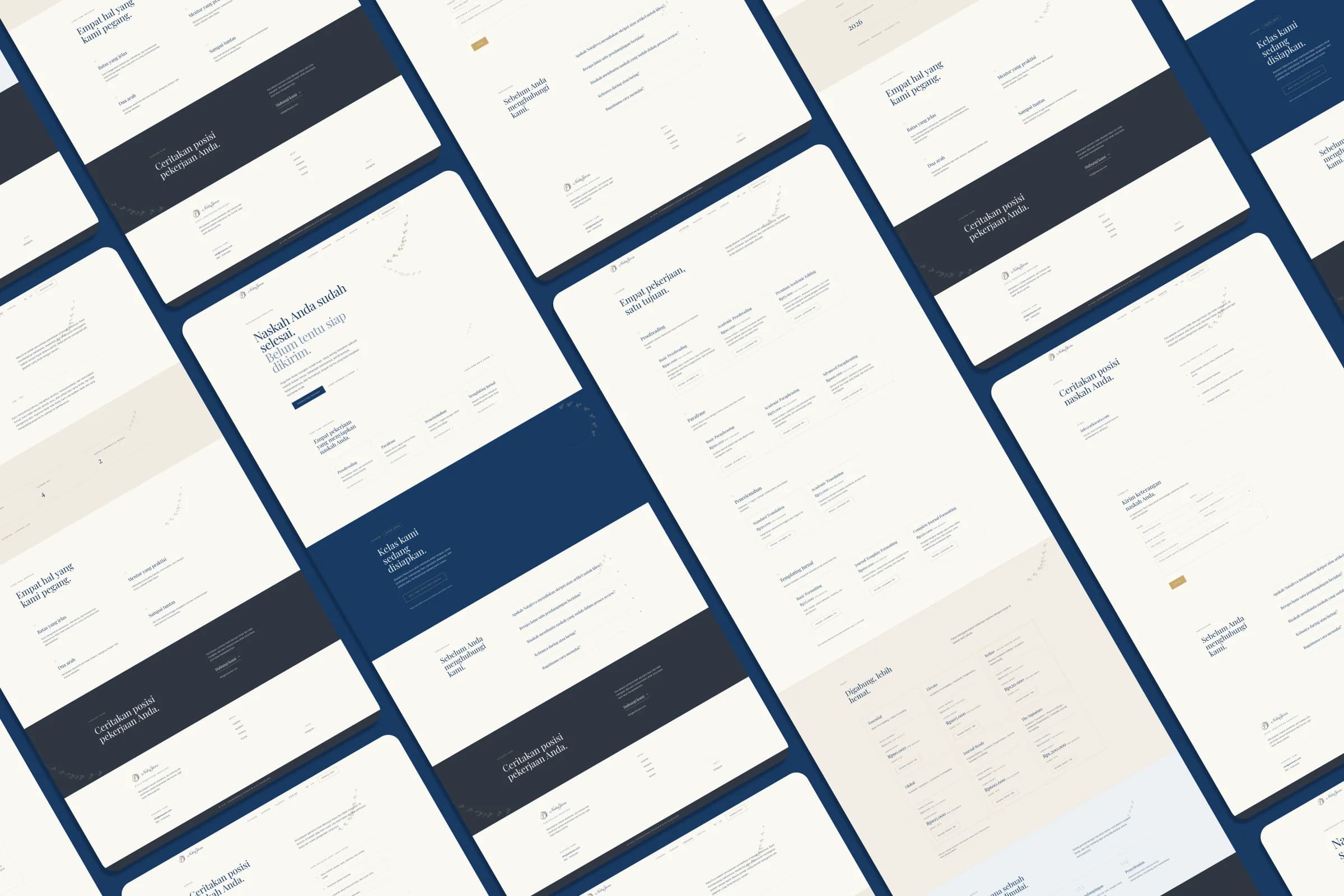
The homepage opens on the objection rather than the offer: your manuscript is finished, which is not the same as ready. It concedes the author's argument is probably sound and locates the problem somewhere less threatening: language, phrasing, translation, format. A reader who has been told their thinking is fine is a reader willing to hear that their manuscript is not.
The homepage concedes the argument is sound before naming what is not. The line, in public
An editing service that touches academic work lives or dies on where it stops. So the boundary is a section of the site rather than a clause in the terms: NataJivva edits language, structure, translation, and formatting, and does not write content or produce data for anyone. The argument stays the author's. Stating it plainly costs nothing and removes the one doubt that keeps people from writing in.
Prices on the page
Four services priced per page, six packages priced per manuscript, all of it visible without an enquiry. Rates that only appear after a conversation teach a reader to expect a negotiation, which is the wrong footing for work sold on trust. Published rates also do the qualifying quietly: the people who write in have already decided the number is fine.
Four services, each tier priced per page and visible without an enquiry. One site, two languages
Indonesian and English are not two sites here. An author writing in Indonesian for an English-language journal moves between the two within a single manuscript, and the site should not make them choose a lane at the door. Both languages carry the same pages, the same rates, and the same wording about what the work is.
Holding ground for the Academy
NataJivva Academy, which offers applied classes in research methodology, academic writing, and data analysis, has a page before it has a curriculum, and says so. It collects interest instead of pretending to enrol. A page that admits it is not open yet is worth more than a launch date nobody can keep.
The outcome
NataJivva launched with its four services, six packages, and full pricing public in both languages, and an Academy page holding the ground for classes still being written. Enquiries arrive already knowing what the work is, what it costs, and where the line sits.
More images
Built with
- Next.js
- TypeScript
- Tailwind CSS
Have a problem shaped like this one?
Tell us what you're working on. We'll tell you honestly whether we're the right fit.